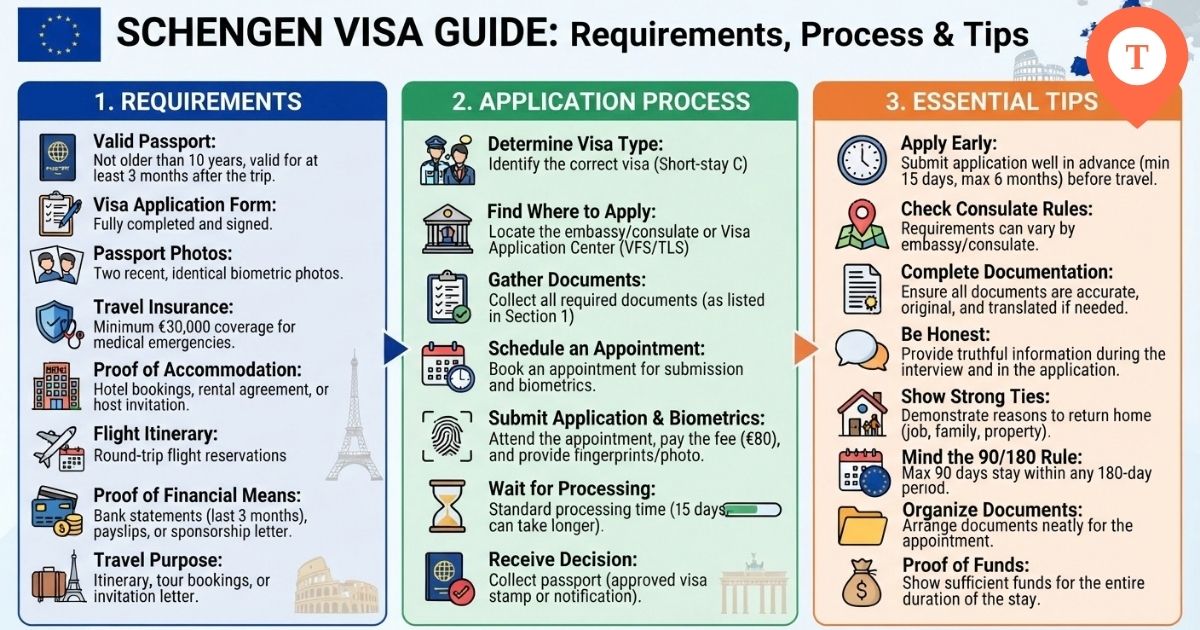
A short-stay Schengen visa generally allows eligible travelers to stay in the Schengen Area for up to 90 days in any 180 days, subject to the conditions and validity of the visa issued.
Standard processing is generally 15 calendar days, but applications can take longer when additional scrutiny or documents are required.
Applicants should allow sufficient time and check the current processing guidance of the relevant consulate or visa application center.
Because appointment availability and processing times can vary, applying well in advance of your planned trip is advisable.
What Is a Schengen Visa
The Schengen Area covers 27 European countries that have abolished passport control at their shared borders, meaning one visa covers all of them for short stays.
It’s worth knowing upfront that this isn’t the same as an EU visa — the UK and Ireland, for instance, are EU-adjacent but not part of Schengen, while Switzerland and Norway are Schengen members without being EU countries. That distinction trips up a surprising number of first-time applicants.
Who Needs a Schengen Visa
Whether you need one depends entirely on your passport’s nationality. Many countries — including the US, Canada, Australia, and the UK — have visa-free access for up to 90 days. Others require a visa arranged in advance, and a growing list will need ETIAS authorization (a lighter, faster process) once it’s fully rolled out.
Budget Tip: Check requirements based on your specific passport, not general assumptions — visa policy varies more than most travelers expect, even between similar countries.
No — ETIAS is a lighter travel authorization for visa-exempt nationalities, not a full visa. It’s a separate, faster process once implemented.
No — the UK left the EU and was never part of Schengen. A separate visa or entry process applies for UK travel.
Required Documents
- Valid passport — with at least three months’ validity beyond your intended official requirement, and at least two blank pages.
- Visa application form — completed and signed, usually available on the consulate’s website.
- Passport-sized photos — meeting Schengen’s specific biometric requirements, which are stricter than a standard passport photo.
- Travel insurance — covering at least €30,000 in medical expenses, valid across the entire Schengen Area for your full trip duration.
- Proof of accommodation — hotel bookings or an invitation letter if staying with someone.
- Proof of onward travel — such as a return or onward itinerary — may be requested as supporting evidence. Check the specific document checklist for your application.
- Proof of sufficient financial means — such as bank statements or other accepted evidence showing that you can support yourself during the trip. The required amount and supporting documents can vary by destination country and application circumstances.
- Cover letter — outlining your travel purpose, itinerary, and intent to return home.
Generally yes, or at minimum a clear itinerary showing where you’ll stay — gaps in accommodation proof can raise questions during review.
Which Consulate Should You Apply Through?
If you are visiting only one Schengen country, you generally apply through the consulate or official visa application service responsible for that country.
If your trip includes several Schengen countries, the correct consulate depends on your main destination:
- One country: Apply through the country you plan to visit.
- Several countries: Apply through the country where you will spend the longest period of your trip or where the main purpose of your visit takes place.
- Equal stays in several countries: If you will spend an equal number of days in multiple Schengen countries and no main destination can be determined, apply through the country whose external border you will cross first when entering the Schengen Area.
You should normally submit your application through the consulate or official visa application provider with territorial responsibility for the country where you legally reside. Some countries use external service providers to collect applications, so check the relevant embassy or consulate website for the correct submission location.
Example
Suppose your itinerary is:
France — 6 nights → Italy — 4 nights → Switzerland — 3 nights
France is your main destination because you will spend the longest period there. You would generally apply through the French authorities responsible for your place of legal residence.
If your itinerary were:
France — 5 nights → Italy — 5 nights → Switzerland — 5 nights
and there is no other main destination based on the purpose of the trip, you would generally apply through the country whose external border you enter first.
Important: Don’t Choose a Consulate Just Because It Has Easier Appointments
Your application should reflect your genuine travel plans. Applying through a country that is not your main destination simply because you believe it may have easier appointment availability is not consistent with the Schengen application rules. The European Commission specifically advises applicants to apply to the correct country based on their itinerary.
Tip: Before booking an appointment, check the current instructions on the relevant embassy/consulate website and confirm which official external service provider, if any, handles applications in your country of legal residence.
Application Process — Step by Step
Step 1: If visiting multiple Schengen countries, you generally apply through the country that is your main destination, based on the length or purpose of your stay. If no main destination can be determined, the application is generally made through the country of first entry.
Step 2: Book an appointment. Many consulates use third-party visa centers (like VFS Global), and appointment slots can fill up weeks in advance during peak travel season.
Step 3: Missing or inconsistent documentation can delay an application or lead to additional requests, so organize your documents according to the relevant checklist.
Step 4: Attend the appointment. This typically includes biometric data collection (fingerprints and photo) alongside document submission.
Step 5: Pay the visa fee. The standard fee is around €0 for adults, though this varies by age and nationality, and is generally non-refundable even if the application is rejected.
Step 6: Wait for processing. Standard processing is 15 calendar days, but budgeting for 30 days is safer, especially between May and August.
As of 2026, the standard Schengen short-stay visa fee is:
Adults: €90
Children aged 6–11: €45
Children under 6: No visa fee
Some applicants covered by visa-facilitation agreements: A different fee may apply.
If you submit your application through an authorised external visa application centre, an additional service fee may apply. The amount and payment method depend on the provider and country where you apply.
The normal processing time for a Schengen visa application is 15 calendar days. However, processing can take up to 45 days when a more detailed examination is required or additional documents are requested.
Because appointment availability and processing times can vary by consulate and application centre, avoid planning your trip around the minimum processing period. Submit your application as early as permitted and check the latest instructions from the relevant consulate or authorised visa application centre.
Common Mistakes to Avoid
Booking flights before visa approval is one of the costliest mistakes — some consulates want flight reservations (not necessarily paid tickets) as proof of itinerary, and there’s a meaningful difference between the two that’s worth clarifying with the specific consulate.
Insufficient bank balance is another frequent rejection reason, though “sufficient” varies by consulate and isn’t always clearly published.
Make sure your financial documents clearly demonstrate that you can reasonably cover the planned trip and related expenses.
Inconsistent information across documents (mismatched dates, addresses, or itinerary details between the cover letter and booking confirmations) raises red flags disproportionate to how minor the error usually is.
Money-Saving Tips for the Application
Apply directly through the consulate when possible rather than a paid visa-assistance service — the process is manageable independently for most travelers, and assistance services often charge $50-100 for what amounts to document-checking.
Buy travel insurance that meets the €30,000 minimum without over-insuring — some providers upsell coverage well beyond what’s required for the visa itself.
If applying with family, check whether children have reduced or waived fees — this varies by age and nationality but is often overlooked.
Find Accommodation for Your Schengen Trip
Having a clear accommodation plan can help you organize your visa application and travel itinerary. Compare hotels, guesthouses, and other stays based on location, price, cancellation options, and your actual travel plans.
→ Compare Hotels & Flexible Stays
Sources
European Commission — Schengen Visa Policy home-affairs.ec.europa.eu, Schengen Visa Info schengenvisainfo.com, VFS Global — Visa Application Centers vfsglobal.com
Frequently Asked Questions (FAQ)
Yes — that’s the entire point of the Schengen Area. One visa allows travel across all 27 member countries within the visa’s validity period.
Yes, it’s mandatory — coverage must be at least €30,000 for medical expenses and valid across the full Schengen Area for your entire trip.
If your application is refused, the decision should state the applicable reason or reasons. You can review the refusal notice and the applicable procedure for requesting a review or submitting a new application, where available.
No, a standard Schengen tourist visa does not permit employment; it’s intended for tourism, business meetings, or visiting family.
Apply through the consulate of the country where you’ll spend the most nights, or your first entry point if time is split evenly.
There’s no universally published figure — it varies by consulate and trip length, so showing clearly more than the minimum expected daily cost is the safer approach.
Extensions are rare and only granted in specific circumstances (medical emergencies, force majeure) — overstaying without approval can affect future visa applications.
Yes, children need their own application, though fees are often reduced or waived depending on age and the specific consulate’s policy.
A cover letter can help explain the purpose of your trip, itinerary, and other relevant circumstances when the application checklist or your circumstances make that explanation useful.
Note: Visa requirements, fees, appointment procedures, and supporting-document requirements can change. Always verify the latest requirements with the relevant official authority before submitting an application.
Affiliate Disclosure
This article contains affiliate links marked with [*]. If you make a purchase or booking through one of these links, TravelABC may earn a commission at no additional cost to you. Our recommendations are based on our editorial review of publicly available information, product and service relevance, and other factors we consider useful to travelers. Learn more in our Affiliate Disclosure Policy.
About the Author
Zunaid Khan is the Co-Founder of TravelABC, where he focuses on budget travel, travel technology, and practical trip-planning content designed to help travelers make more informed booking and travel decisions.
Discover more from TravelABC
Subscribe to get the latest posts sent to your email.