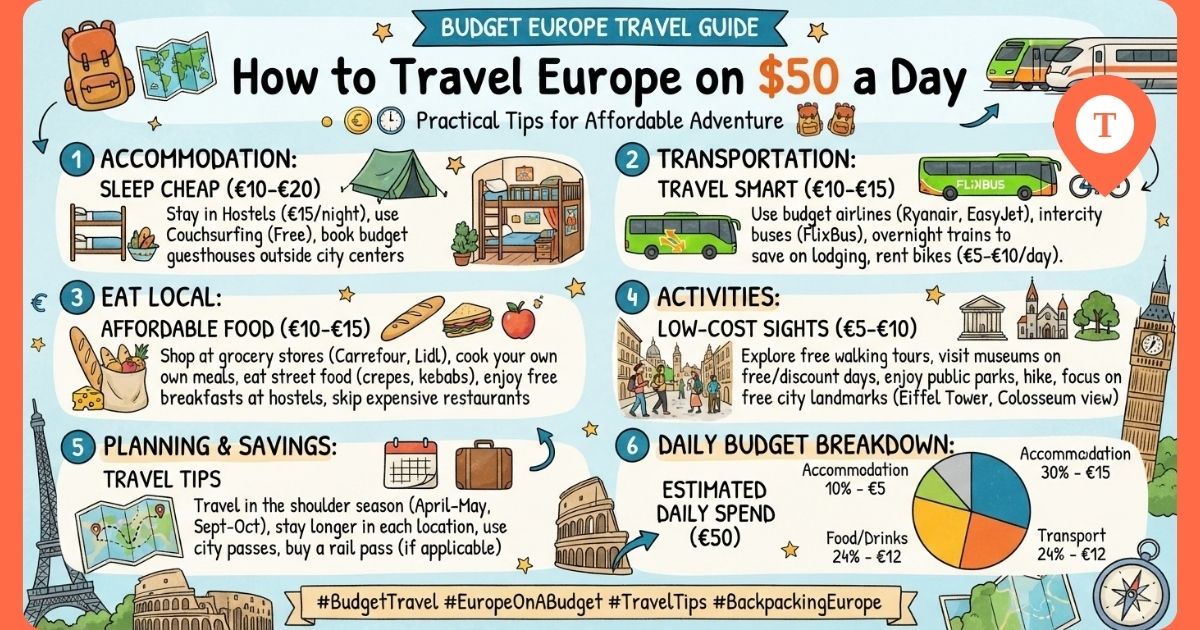
Traveling Europe on $50 a day is realistic across most of Eastern Europe, the Balkans, and Portugal, though Western European hubs like Paris or Amsterdam require more careful budgeting to hit that number.
The key is combining hostel accommodation ($15-20), cooking or eating local food ($10-15), and using public transport or walking ($5-10) — with the remaining buffer for activities and unexpected costs.
Remember to budget separately for flights, intercity transportation, visa fees, insurance, and major activities.
Setting the Baseline: What $50 Actually Covers
Fifty dollars a day sounds tight until you break it down. Realistically, that’s $15-20 for a hostel dorm bed, $10-15 for food if you’re mixing cooking with the occasional cheap restaurant meal, $5-10 for local transport, and whatever’s left — usually $10-15 — for activities, museum entries, or the odd splurge. It’s not a lot of margin, but it’s genuinely doable in the right countries.
Where it falls apart is Western Europe’s big cities. Paris, Amsterdam, or Zurich will eat that entire budget on accommodation alone some nights. The trick isn’t stretching $50 everywhere — it’s choosing a route where $50 is a comfortable average, not a daily struggle.
Where $50 a Day Works Best
Eastern Europe is the clearest answer here. Countries like Poland, Hungary, Bulgaria, and Romania routinely come in under $50, sometimes well under — leaving room for a nicer meal or a paid activity without guilt. Portugal is the closest Western European country that still fits comfortably, especially outside Lisbon’s city center.
The Balkans — Serbia, Bosnia, North Macedonia — are arguably even cheaper, though transport infrastructure is a bit rougher around the edges, which can cost you time even when it doesn’t cost money.
Budget Tip: Build your route around 2-3 "cheap" countries with a short, planned splurge in one pricier city, rather than trying to hit $50 uniformly everywhere.
Poland, Hungary, Bulgaria, Romania, and the Balkan countries consistently come in under or around $50 a day.
It’s difficult in major cities but doable in smaller towns — Portugal outside Lisbon’s center is the most realistic Western European option.
Accommodation Strategy
Hostels remain the backbone of a $50/day trip, but not all hostels are priced equally — a dorm bed in Krakow might run $10, while the same bed in central Amsterdam can hit $40 on its own.
Booking a few days ahead, rather than same-day, usually locks in better rates, and staying slightly outside the historic center often cuts costs by 30-40% for a 10-15 minute longer walk.
Worth mentioning: some hostels include breakfast, which quietly saves $5-8 a day if you factor it into the comparison rather than just looking at the nightly rate.
Well-reviewed hostels are widely used by budget travelers, but safety varies by property. Check recent reviews, location, security features, lockers, and reception arrangements before booking.
Find Affordable Accommodation in Europe
Accommodation can make or break a $50-a-day travel budget. Compare hostels, guesthouses, and budget hotels by price, location, ratings, and cancellation options before you book.
Food: Where the Real Savings Happen
Food is where a $50 budget is won or lost. Cooking even one meal a day in a hostel kitchen — usually breakfast or a simple pasta dinner — can save $8-10 compared to eating out for every meal.
When eating out, lunch specials (common across much of Europe) are almost always cheaper than the same dish at dinner.
Markets are underused by travelers on tight budgets, and that’s a missed opportunity — fresh bread, cheese, and produce from a local market usually cost half what a grocery store aimed at tourists charges for the same items.
Budget Tip: Skip restaurants directly on main squares or near major attractions — walking two streets away typically cuts prices in half for comparable food.
Not entirely, but cooking at least one meal a day makes the budget noticeably more comfortable and leaves room for occasional splurges.
Roughly $10-15 a day if mixing home-cooked meals with occasional cheap restaurant food or lunch specials.
Transport: Moving Between Cities Cheaply
Budget airlines (Ryanair, Wizz Air, EasyJet) can be shockingly cheap for intercity hops if booked with minimal baggage — but the fees add up fast if you’re not careful about carry-on limits.
For shorter distances, buses (FlixBus especially) are often cheaper than trains and only marginally slower.
Within cities, walking covers more ground than most travelers expect, and public transport day passes almost always beat single tickets if you’re taking more than two rides.
Budget Tip: Compare the total cost of a budget flight (including baggage fees) against a bus or train before assuming flying is cheaper — it often isn’t once fees are added.
It depends — budget airlines can be cheaper for longer distances, but buses often win once baggage fees are factored in, especially for shorter routes.
Public transport almost always beats taxis or airport shuttles, often costing a fraction of the price for a similar travel time.
Compare Your European Transport Options
A cheap flight isn’t always the cheapest journey once baggage and airport transfer costs are included. Compare flights, buses, and other transport options to find the route that fits your budget.
Sample 7-Day Budget Breakdown
| Category | Daily Cost | 7-Day Total |
|---|---|---|
| Accommodation | $18 | $126 |
| Food | $12 | $84 |
| Local transport | $7 | $49 |
| Activities/buffer | $13 | $91 |
| Total | $50 | $350 |
$50/Day Budget: What This Includes
The $50 daily budget in this guide is an illustrative target for a solo budget traveler. It generally assumes hostel accommodation, mostly low-cost meals, local transportation, and modest spending on activities.
International flights, intercity transport, visa fees, travel insurance, shopping, nightlife, and major tours are excluded. Actual costs vary by destination, season, exchange rates, and travel style.
Use the $50 figure as a planning target rather than a fixed daily price.
How to Keep the Budget on Track
Staying within a $50 daily target is less about cutting every expense and more about knowing where your money is going. A few simple habits can help prevent small purchases from quietly turning into a much bigger travel bill.
Set a Daily Spending Limit
Treat $50 as a target rather than a rule you have to hit perfectly every single day. You might spend $40 on a quiet travel day and $65 on a day with a major attraction or longer journey. Tracking your average across several days gives you more flexibility.
Track Your Spending
Use a notes app, spreadsheet, or budgeting app to record accommodation, food, transport, and activities. Checking your spending once a day makes it easier to spot where you’re going over budget before the problem grows.
Keep Accommodation Costs Under Control
Accommodation is often one of the biggest expenses on a budget trip. Compare several properties before booking and consider location, transport costs, breakfast, and cancellation terms—not just the nightly price.
Build a Small Buffer
Don’t allocate every dollar of your $50 target in advance. Keeping a small amount available for unexpected transport costs, price changes, or an occasional treat can make the trip much less stressful.
Watch the Small Expenses
Coffee, snacks, convenience-store purchases, attraction fees, and short taxi rides may seem insignificant individually. Over a week, however, several small purchases can add up. Give yourself a daily allowance for these extras rather than ignoring them.
Review Your Budget Every Few Days
If you’re spending more than planned, adjust early. You might choose a cheaper meal, walk instead of taking public transport for a short journey, or spend an extra night in a lower-cost destination. Small adjustments are easier than trying to recover from a large overspend at the end of the trip.
Budget Tip: Focus on your average daily spending across the trip, not whether every individual day comes in exactly at $50.
Sources
Numbeo — Cost of Living Index numbeo.com/cost-of-living, Budget Your Trip — Europe Travel Costs budgetyourtrip.com, Hostelworld — Average Hostel Pricing Data hostelworld.comFrequently Asked Questions (FAQ)
Yes, in most of Eastern Europe, the Balkans, and Portugal — Western European capitals like Paris or Amsterdam make it tighter but not impossible with careful planning.
Around $15-20 a night for a hostel dorm bed, though this varies significantly by country and city center proximity.
Accommodation, by far — it’s the category most likely to break a $50/day budget if booked last-minute or in city centers.
That depends more on trip length than budget — a 2-3 week trip covering 3-4 neighboring budget-friendly countries is a realistic, comfortable pace.
No — travel insurance should be budgeted separately, typically $1-3 a day depending on coverage and trip length.
Affiliate Disclosure
This article contains affiliate links marked with [*]. If you make a purchase or booking through one of these links, TravelABC may earn a commission at no additional cost to you. Our recommendations are based on our editorial review of publicly available information, product and service relevance, and other factors we consider useful to travelers. Learn more in our Affiliate Disclosure Policy.
About the Author
Zunaid Khan is the Co-Founder of TravelABC, where he focuses on budget travel, travel technology, and practical trip-planning content designed to help travelers make more informed booking and travel decisions.
Discover more from TravelABC
Subscribe to get the latest posts sent to your email.