
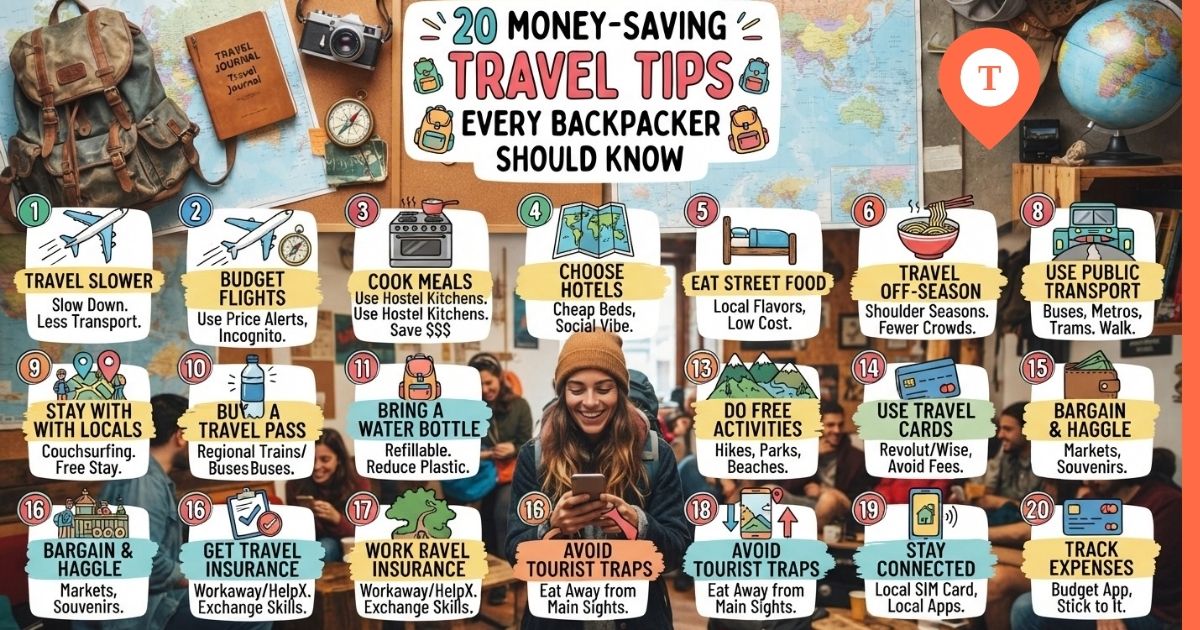
The best money-saving travel tips for backpackers include booking flights in incognito mode, using overnight transport to save on accommodation, eating where locals eat, and travel hacking with points and miles.
Combining several of these habits can make a noticeable difference to your overall backpacking budget, especially on longer trips.
Booking & Planning
- Search flights across multiple dates and booking platforms. Prices can change based on demand, availability, timing, and other factors, so comparing dates and fares is more useful than repeatedly checking the same search.
Be flexible with dates, not just destinations. Shifting a flight by even two or three days can drop the price by $50-100, especially around weekends and holidays.
Traveling during the shoulder season can often mean lower accommodation prices and fewer crowds, although the exact timing varies by destination.
Use flight alert tools instead of checking manually. Setting a price alert and forgetting about it beats refreshing search results daily, and it removes the temptation to book too early out of anxiety.
✈️ Find Cheaper Flights
Flexible with your travel dates? Compare flight prices across different dates and routes, and set price alerts so you can spot a better fare when it appears.
[*]👉 Compare Flight Deals
Accommodation
- Stay in hostels with kitchens. This one sounds obvious, but it’s genuinely one of the biggest savings on this list — cooking even half your meals can save $10-15 a day.
Try house-sitting or work exchanges. Platforms like Worldpackers or TrustedHousesitters trade a few hours of help for free accommodation — not for everyone, but transformative for long-term budgets.
Book longer stays for weekly discounts. Many hostels and guesthouses quietly offer 10-20% off for stays of 5+ nights, even if it’s not advertised on the booking page.
Use overnight buses or trains strategically. This is the classic two-for-one — you save a night of accommodation and arrive somewhere new by morning.
🏨 Save on Accommodation
Hostels aren’t your only budget option. Compare hostels, guesthouses, and budget hotels to find a comfortable stay that fits your backpacking budget.
[*]👉 Compare Budget Accommodation
Food
- A busy local restaurant can be a useful signal that the food is popular with residents, although it isn’t a guarantee of quality or price.
Shop at local markets for snacks and produce. Markets are consistently cheaper than convenience stores or supermarkets aimed at tourists, and the food is usually fresher.
Walking a few streets away from major attractions can often reveal restaurants with lower prices than those directly around tourist hotspots.
Take advantage of lunch specials. Many restaurants — especially in Europe and Southeast Asia — offer significantly cheaper set menus at lunch than the same dishes at dinner.
Transport
- Walk or cycle instead of relying on taxis. Most cities are more walkable than they first appear, and it’s often the best way to actually see a place anyway.
Multi-day transit passes can offer better value if you’re making several journeys each day, but compare the pass price with the fares you actually expect to use.
Negotiate or confirm fares before getting in. In places without metered taxis, agreeing on a price upfront avoids the inflated “tourist rate” entirely.
Money & Points
- Use a no-foreign-transaction-fee card. This is one of the easiest wins on the list — a 3% fee on every purchase adds up fast over a long trip, for zero benefit.
- If your bank or ATM charges a flat withdrawal fee, fewer larger withdrawals may reduce the fee you pay overall. Check your bank’s fee structure first.
Travel hack with credit card points. Sign-up bonuses on travel credit cards can cover an entire flight if used strategically — worth researching before a long trip, not during one
Activities & Extras
- Look for free walking tours. Most major cities have tip-based, genuinely excellent walking tours — you pay what you think it was worth, which is usually less than a paid tour.
Buy multi-attraction passes only if you’ll actually use them. These can be a great deal or a waste of money depending on your itinerary — do the math on 3-4 attractions before buying.
How Small Savings Can Add Up
Here’s a simple hypothetical example of how several budget choices could reduce a $50 daily travel budget. These figures are illustrative, not average prices or guaranteed savings.
| Expense | Standard Budget | With Budget Strategies |
|---|---|---|
| Accommodation | $20 | $15 |
| Food | $15 | $10 |
| Transport | $8 | $5 |
| Activities | $5 | $3 |
| Miscellaneous | $2 | $2 |
| Total | $50 | $35 |
The point isn’t that every traveler will save exactly $15 a day. Your actual savings will depend on the destination, season, accommodation, transport choices, and travel style.
🎟️ Find Affordable Things to Do
Saving money doesn’t mean skipping experiences. Compare walking tours, attractions, day trips, and local activities before booking.
Before You Book: A Backpacker Budget Checklist
Before you confirm your trip, run through this quick checklist:
☐ Compare flight prices across flexible dates
☐ Check baggage fees before choosing a fare
☐ Compare hostel and guesthouse prices
☐ Check whether longer stays qualify for a discount
☐ Compare transport passes with individual fares
☐ Check your card’s foreign transaction fees
☐ Compare travel insurance options
☐ Look for free or tip-based activities at your destination
Sources
Numbeo — Cost of Living Index numbeo.com/cost-of-living, Budget Your Trip — Travel Cost Data budgetyourtrip.com, NerdWallet — No Foreign Transaction Fee Cards, nerdwallet.comFrequently Asked Questions (FAQ)
Cooking your own food in hostel kitchens tends to save the most overall — it’s the one habit that compounds daily.
Combining even five or six tips typically cuts a daily budget by 30-40%, turning something like $50/day into $30/day.
Yes, if you have time to plan — sign-up bonuses can cover an entire flight, but you need to arrange them months in advance, not the week before departure.
Generally yes — you save both transport time and a night of accommodation, though comfort varies a lot by country and operator.
Withdrawing small amounts from ATMs frequently — flat fees mean you’re paying the same charge for $50 as you would for $200.
No, though tipping is expected — most travelers give $5-10 depending on the city and tour length.
It varies — booking usually locks in lower prices, but negotiating in person can work in low-season destinations with excess supply.
They prevent price tracking based on repeated searches from the same browser, which some airlines and booking sites use to nudge prices upward.
Eating where locals eat and shopping at markets, rather than tourist-area restaurants or convenience stores, makes the biggest daily difference.
Only if you’ll realistically visit 3-4 included attractions — otherwise you’re often better off paying individual entry fees.
Yes, for travelers with flexible schedules — it trades a few hours of help for free accommodation, though it requires more planning than a hostel booking.
Multi-day transit passes usually cost a fraction of what the equivalent number of taxi rides would, especially in well-connected European cities.
Affiliate Disclosure
This article contains affiliate links marked with [*]. If you make a purchase or booking through one of these links, TravelABC may earn a commission at no additional cost to you. Our recommendations are based on our editorial review of publicly available information, product and service relevance, and other factors we consider useful to travelers. Learn more in our Affiliate Disclosure Policy.
About the Author
Zunaid Khan is the CEO of TravelABC, where he focuses on budget travel, travel technology, and practical trip-planning content designed to help travelers make more informed booking and travel decisions.