
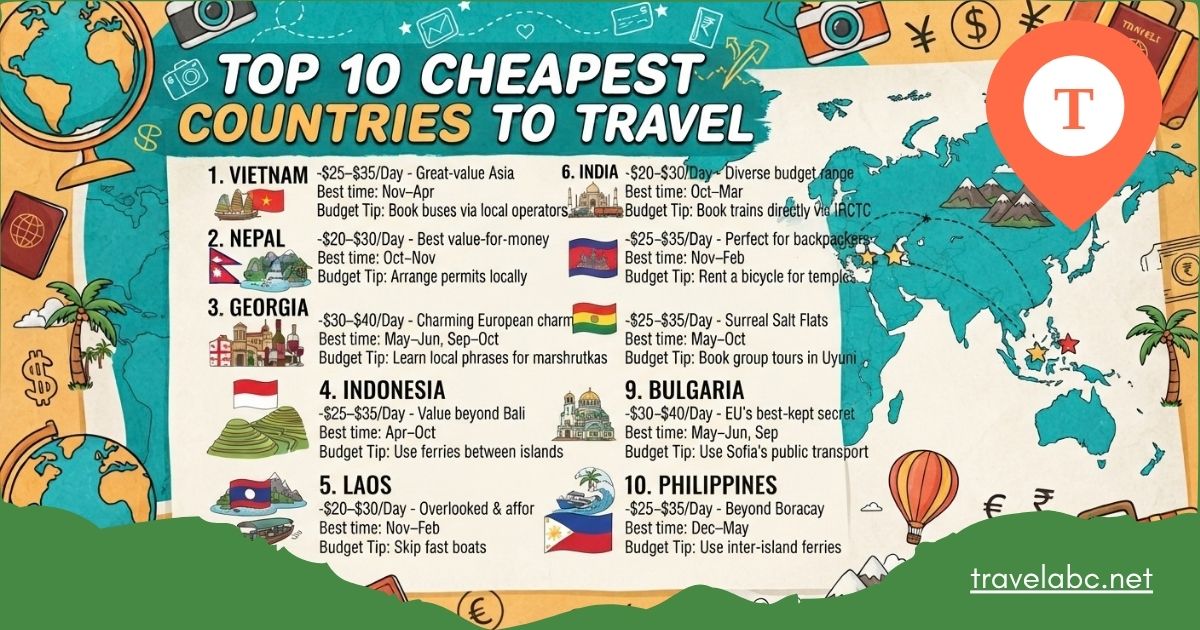
The cheapest countries to travel in 2027 include Vietnam, Nepal, Georgia, Indonesia, and Laos, where daily budgets can range from $20–$40, including food, accommodation, and local transport.
Southeast Asia and the Caucasus region remain the most affordable areas for travelers, offering low-cost hostels, cheap street food, and inexpensive intercity transport — making them ideal for backpackers and long-term travelers on a budget.
| Country | Estimated Daily Budget |
|---|---|
| Vietnam | $25–35 |
| Nepal | $20–30 |
| Georgia | $30–40 |
| Indonesia | $25–35 |
| Laos | $20–30 |
How We Calculate Daily Travel Budgets: The daily budgets in this guide are approximate estimates for a solo budget traveler.
They generally assume a hostel bed or basic guesthouse, mostly local meals, public transportation, and a small amount of everyday travel spending.
These estimates exclude international flights, visa fees, travel insurance, shopping, alcohol, nightlife, and expensive tours or activities.
Accommodation and food costs can also vary significantly between major cities, tourist hotspots, smaller towns, and rural areas.
Actual spending will depend on your travel style, destination, season, exchange rates, and how often you move between places. Treat the figures as a practical planning range rather than a fixed daily price.
Vietnam — $25–$35/Day
Vietnam is still really one of the best-value destinations in Asia — and honestly, it’s a little underrated compared to how much hype Thailand gets.
You’ll find hostel beds for $5–$10 a night, and street food is almost cheap; a bowl of pho rarely costs more than $2, even in Hanoi’s Old Quarter.
What surprised me most while researching this is how good the overnight bus network is.
It sounds uncomfortable on paper, but sleeper buses between Hanoi and Hue are actually reclining beds, and you save a night of accommodation while covering ground.
Best time to visit: November–April, before the summer humidity hits.
Budget Tip: Booking directly with local operators can sometimes cost less than booking through international platforms, although the difference varies by operator and activity.
Nepal — $20–$30/Day
Nepal might be the single best value-for-money destination on this list.
Once you’re outside Kathmandu’s Thamel district — which does have some tourist-priced restaurants — costs drop fast.
A teahouse stay along the Annapurna route with a hot meal included can run under $10.
Trekking permits are where people often overpay. Going through an international booking agency instead of arranging it locally in Kathmandu can be substantially more expensive for essentially the same paperwork.
Best time to visit: October–November, when the skies are clearest post-monsoon.
Budget Tip: Arrange permits and porters locally rather than pre-booking from abroad.
Georgia — $30–$40/Day
Georgia is the one country on this list that feels like it shouldn’t be this cheap.
Tbilisi has the charm and architecture you’d expect from a European capital, but wine tastings, guesthouse stays, and khinkali dinners cost a fraction of what you’d pay in, say, Portugal.
The marshrutkas (shared minivans) take some getting used to — no fixed schedule; they leave when full — but they’re absurdly cheap compared to taxis, often a fifth of the price for the same route.
Best time to visit: May–June or September–October, avoiding both winter cold and summer crowds.
Budget Tip: Learn a few Georgian or Russian phrases — English isn't widely spoken outside Tbilisi, and marshrutka drivers rarely take card payments.
Indonesia — $25–$35/Day
Everyone talks about Bali, but honestly, the real value in Indonesia is everywhere else.
Lombok and Flores offer the same turquoise water and rice-terrace views at significantly cheaper, mostly because the infrastructure for mass tourism just hasn’t caught up yet — which, depending on how you look at it, is either an inconvenience or the whole point.
Warungs (local family-run eateries) are where the real savings happen — a full plate of nasi goreng with a fresh juice rarely tops $2-3, even in touristy areas.
Best time to visit: April–October, during the dry season.
Budget Tip: Domestic flights between islands are cheap if booked 3-4 weeks out, but ferries — while slower — can cost a third of the price.
Laos — $20–$30/Day
Laos is probably the most overlooked country on this entire list, and that’s exactly why it’s so cheap.
It gets a fraction of the tourists Vietnam or Thailand do, so prices haven’t inflated the way they have next door. Luang Prabang’s guesthouses run $8-12 a night, and that’s already on the nicer end.
The slow boat down the Mekong from the Thai border is a two-day trip, and it’s slow in every sense — but at $25-30 total including a night’s stopover, it’s hard to beat.
Best time to visit: November–February, cool and dry.
Budget Tip: Skip the fast boats — they're louder, more dangerous, and barely cheaper than the slow route.
India — $20–$30/Day
India is where budget travel gets interesting, because the range is so wide. You could spend $15 a day or $150 — the difference is entirely in how you travel.
Sleeper class trains, which locals use daily, cost a fraction of tourist-class options and, frankly, are part of the experience.
Street food is where most people get nervous, but stalls with high turnover (look for a queue) are usually both the cheapest and safest option — a full thali can run under $2.
Best time to visit: October–March, avoiding the worst of the heat.
Budget Tip: Book trains through IRCTC directly; third-party booking sites often add a markup that adds up over a long trip.
Cambodia — $25–$35/Day
Cambodia pairs naturally with Vietnam and Laos if you’re doing a regional loop, and Siem Reap in particular has built its entire economy around budget backpackers — hostels here are genuinely social, not just cheap.
Angkor Wat’s pricing is a bit of a trap if you don’t plan — the one-day pass looks tempting, but the 3-day pass costs barely more and gives you time actually to avoid the worst of the midday heat and crowds.
Best time to visit: November–February.
Budget Tip: Rent a bicycle instead of hiring a tuk-tuk for temple-hopping — it's a fraction of the cost and honestly more pleasant before 9 am.
Bolivia — $25–$35/Day
Bolivia doesn’t get the attention Peru does, which works in budget travelers’ favor.
The Uyuni Salt Flats are one of Bolivia’s biggest draws, and group tours can be relatively affordable compared with similar multi-day experiences elsewhere in South America.
Group tours from Uyuni are where the savings really show up; going private can cost three or four times as much for essentially the same route.
Best time to visit: May–October, the dry season, when the salt flats' mirror effect is more predictable.
Budget Tip: Book your Salt Flats tour in Uyuni itself rather than through an agency in La Paz — the markup for "convenience" is steep.
Bulgaria — $30–$40/Day
Bulgaria is one of the more affordable destinations in the EU, particularly for travelers comparing accommodation, food, and local transport costs. And it’s a little baffling that it isn’t more well-known.
Sofia’s public transport card is cheap and covers most of what a first-time visitor would want to see, which isn’t something you can say about many European capitals.
Best time to visit: May–June or September, avoiding both winter cold and peak summer heat.
Budget Tip: Skip central Sofia restaurants near Vitosha Boulevard — walk two streets over and prices drop noticeably for the same quality.
Philippines — $25–$35/Day
Boracay and Palawan get the Instagram attention, and the prices reflect it.
But the Philippines has over 7,000 islands, and most of them haven’t seen that kind of tourist markup — Siargao, for instance, still feels relatively undiscovered despite its growing surf reputation.
Inter-island ferries are the budget option, though “budget” here means trading speed for savings — a ferry can take half a day where a flight takes 45 minutes.
Best time to visit: December–May, dry season.
Budget Tip: If time allows, ferries plus local jeepneys will cut your transport costs dramatically compared to relying on domestic flights.
Ready to Plan Your Trip?
Once you’ve picked your destination, compare flights, accommodation, activities, and other travel options to build your trip around your budget.
[*]👉 Compare Travel Deals
Frequently Asked Questions (FAQ)
Nepal and Laos can be among the lowest-cost options on this list, with shoestring travelers sometimes managing around $20–$30 per day.
Yes, though it takes a bit of intentionality. In Nepal, Laos, and rural parts of Vietnam or Cambodia, $20 covers a bed, three meals, and local transport—but it doesn’t leave much room to splurge on tours or Western-style cafes.
Southeast Asia, hands down. South Asia comes close behind, and the Caucasus (Georgia especially) is quietly becoming a budget favorite for people who’ve already “done” Southeast Asia.
Bulgaria is among Europe’s more affordable destinations, while Georgia is another relatively low-cost option in the Caucasus region
They’re close, but Vietnam usually edges out slightly cheaper, particularly for food and long-distance travel. Thailand’s tourist infrastructure is more developed, which comes with a small price premium.
Shoulder season is the sweet spot almost everywhere on this list — you get lower prices than peak season without the worst weather that comes with the off-season.
No. Every figure here is ground-level costs — accommodation, food, local transport — not international flights, which vary too much by origin to generalize.
Bolivia stands out as the cheapest option by a fair margin. Peru and Colombia are still reasonable but noticeably pricier once you factor in the more developed tourist trail.
Hostels and guesthouses over hotels are the obvious one, but booking a week at a time instead of night-by-night often gets you a meaningful discount that most travelers don’t bother asking for.
Traveling on a budget does not automatically mean compromising on safety, but conditions vary by destination. Use reputable accommodation and transport, follow local guidance, and consider travel insurance.
Buses and shared vans, almost always. Georgia’s marshrutkas and Vietnam’s sleeper buses are both good examples of transport that’s cheap precisely because it’s not built for tourists.
It varies a lot by nationality. Vietnam, Cambodia, and India require visas for most travelers, while several others offer visa-free entry or visa-on-arrival — worth checking well before booking flights.
Nepal, without much competition. The teahouse system along routes like Annapurna means you’re never far from an affordable bed and hot meal, even at altitude.
Yes, though realistically your budget will run higher than a solo backpacker’s — private rooms and kid-friendly activities add up. Vietnam and Bulgaria tend to be more family-manageable than, say, remote parts of Laos.
Vietnam is the one I’d point most beginners toward — it’s affordable, well set up for independent travel, and forgiving if you make rookie mistakes.
Sources
- Numbeo — Cost of Living Index- numbeo.com/cost-of-living
- Budget Your Trip — Country-wise Travel Cost Data- budgetyourtrip.com
- Vietnam National Authority of Tourism- vietnamtourism.gov.vn
- Nepal Tourism Board- ntb.gov.np
- Georgian National Tourism Administration- gnta.ge
Affiliate Disclosure
This article contains affiliate links marked with [*]. If you make a purchase or booking through one of these links, TravelABC may earn a commission at no additional cost to you. Our recommendations are based on our editorial review of publicly available information, product and service relevance, and other factors we consider useful to travelers. Learn more in our Affiliate Disclosure Policy.
About the Author
Zunaid Khan is the CEO of TravelABC, where he focuses on budget travel, travel technology, and practical trip-planning content designed to help travelers make more informed booking and travel decisions.